


Benjamin Thomas Kohler - Jue, 27/11/2025 - 20:23
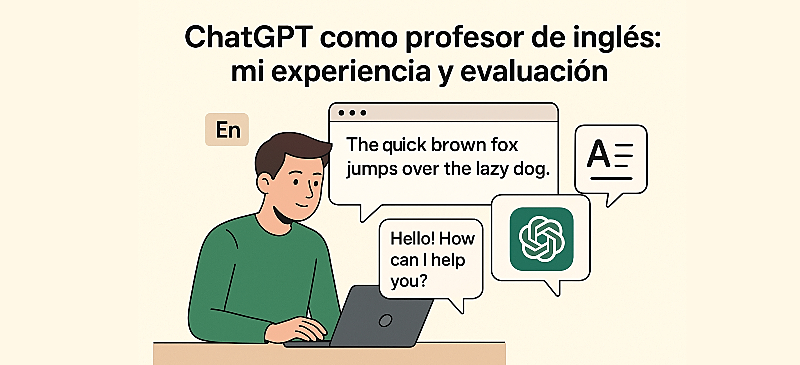
Image created by AI. Source: ChatGPT, 2025.
Serie: 'Bites of wisdom' (XXI)
Modern language learning requires modern tools, and which one could be better than the ubiquitous and enigmatic ChatGPT? – the large language model (LLM) AI “chatbot” that is changing how we use the Internet to obtain and analyze information.
Professionally, I have used our best AI “friend” for writing, editing, and organizing course materials as well as for research. Personally, I have used it to answer questions, to propose and clarify ideas, and to summarize information. Up until now, however, I had never tried to use it to learn a language. In this blog entry, I’ll describe my experience and perspective as a language teacher on my future replacement (just kidding… I hope!): ChatGPT, AI language instructor.
Words in english.
I should first say that I’m a fairly tech-savvy user who expects a lot from technology. I grew up working and playing on computers, and while I’m often impressed by ChatGPT’s abilities, I’ve also grown frustrated by its limits. It can be brilliant one moment and strangely unhelpful the next. I’ve even caught myself criticizing it “to its face”—a habit one friend warns could be risky in the event of an AI uprising.
All jokes aside, the first caveat to studying English with ChatGPT is organization. Learning this way requires initiative. It can be rich and personalized, but not everyone knows how or wants to structure their own learning. For those learners, paid apps with built-in lessons and progress tracking may be better. ChatGPT’s main strengths are that it can be free, flexible, and fully customizable, allowing learners to adapt and expand their practice if they know or learn how to guide it with proper prompts and plenty of patience (the 4 Ps of working with ChatGPT!).
With that in mind, I evaluated the current model of ChatGPT (GPT-5) across the four core language skills: reading, writing, listening, and speaking.
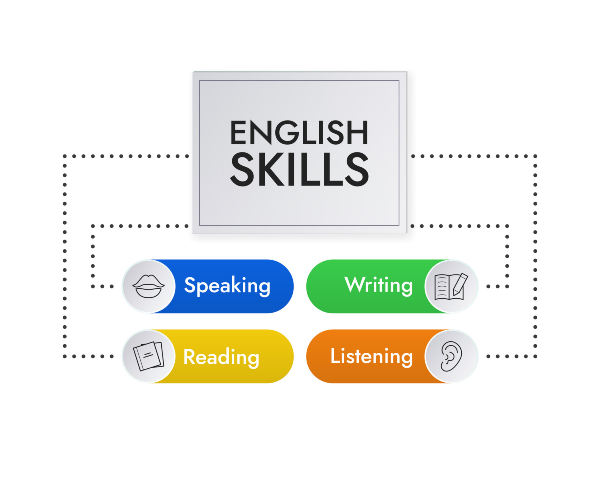
Skills in English.
Reading
Students can request texts at their level, ask for explanations, and generate quizzes instantly. Generated texts are not “authentic”, but they are highly accurate and based on natural language use.
Real texts can be copied, pasted, and utilized.
Rating: Most effective skill for structured learning.
Writing
ChatGPT gives instant feedback on a student’s grammar, vocabulary, style, and organization. It explains mistakes and can model improved versions.
The danger lies in overreliance—students may stop thinking critically and simply let the AI write or rewrite everything.
Rating: Very powerful but requires discipline to avoid dependency.
Listening
In voice mode, students can hear a number of different clear, neutral accents and control the playback speed.
Listening exercises can also be generated, though authentic transcripts from YouTube videos can also be copied, pasted, and utilized.
Rating: Useful but limited; best for practice, not immersion.
Speaking
The voice mode of ChatGPT is interesting for shy students who want to build confidence. Conversation is possible, but it is halted and quite unnatural.
The ASR (Automatic Speech Recognition) detects speech and attempts to convert it to text, though for a speaker of a foreign language this may require a higher level in order to be more successful. In addition, ChatGPT can’t accurately assess pronunciation or stress, which is essential for real communication.
Rating: Helpful only for confidence; weak for pronunciation and fluency.
If you use ChatGPT but have never tried using it to practice or study English, you ought to give it a try. This technology will no doubt improve and become increasingly integrated into everything we do on the Internet, so experimenting with it now can only widen your toolkit.
Lastly, don’t forget that you can use both your native language and English simultaneously when writing or speaking with ChatGPT, as it handles bilingual communication easily and naturally. This can be tremendously helpful for reducing confusion, reinforcing understanding, and allowing you to move smoothly between learning and communicating.
Editor: Universidad Isabel I
ISSN 3020-321X
Burgos, España